
Mastering Service Integration and Management (SIAM)
An In-Depth Guide to Building Unified, High-Performance Multi-Vendor Ecosystems
Table of Contents
Introduction
As enterprises grow increasingly digital, they depend on a complex ecosystem of service providers—cloud vendors, application developers, network operators, cybersecurity partners, and more. While outsourcing and multi-sourcing offer flexibility and cost efficiency, they also introduce significant challenges: fragmented accountability, inconsistent performance, and blurred ownership of outcomes.
In this environment, Service Integration and Management (SIAM) has emerged as a structured approach to orchestrate and govern diverse providers. SIAM ensures that the organization retains end-to-end control, visibility, and accountability while leveraging specialized expertise from multiple suppliers.
In simple terms, SIAM enables organizations to “act as one” across multiple vendors. It integrates services, processes, tools, and governance frameworks to deliver seamless, high-quality business services to end users.
This comprehensive guide explores what SIAM is, why it matters, how it works, and how organizations can successfully implement it to drive transformation, agility, and business value.
What is SIAM?
Definition
Service Integration and Management (SIAM) is a management methodology and operating model that coordinates multiple service providers to deliver a unified set of business-aligned IT services.
Unlike traditional vendor management, which focuses on contracts and SLAs at the provider level, SIAM ensures end-to-end accountability, meaning the business receives a complete service experience without worrying about which vendor provides which part.
In short:
SIAM = IT Service Management + Multi-Vendor Coordination + Governance
Core Principles of SIAM
Successfully implementing Service Integration and Management (SIAM) requires adherence to several foundational principles that guide governance, process design, and provider collaboration. These principles ensure that multi-vendor environments operate as a single, cohesive ecosystem rather than a set of disconnected services.
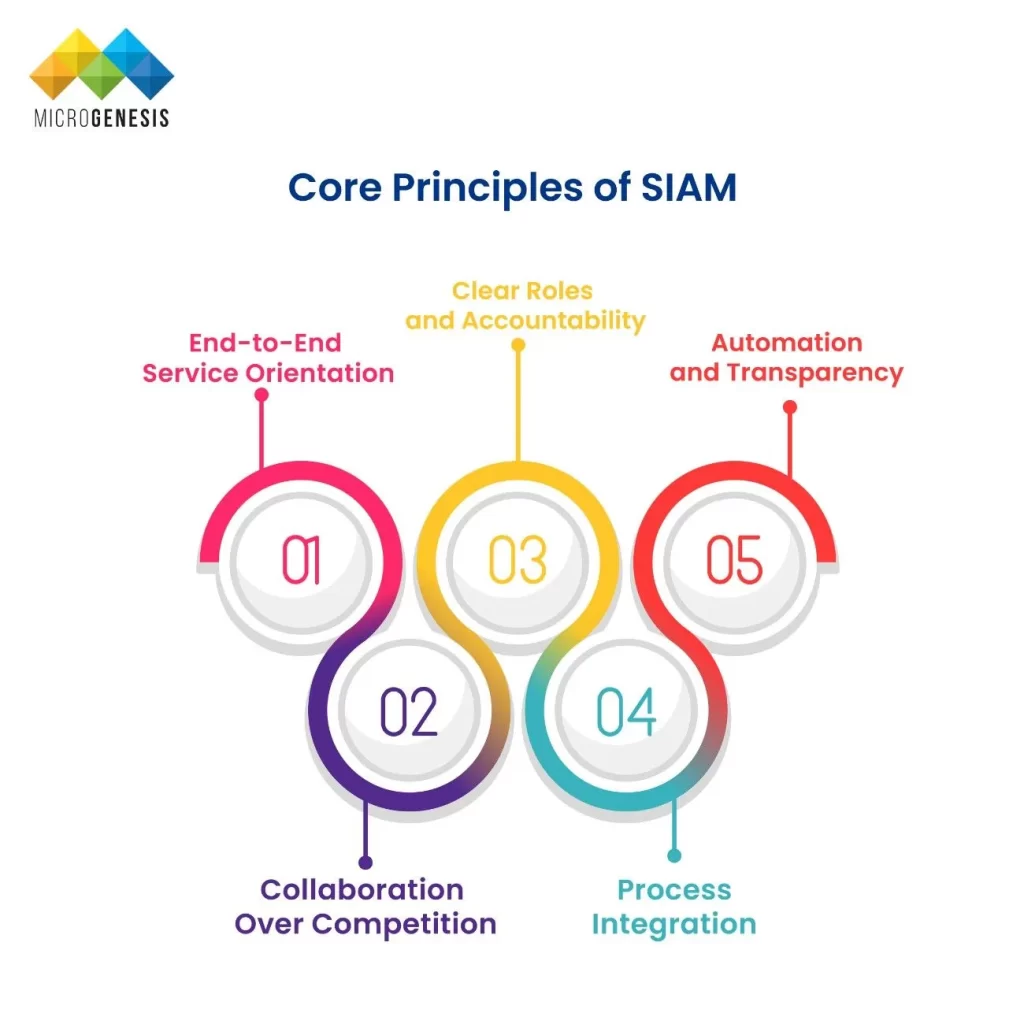
End-to-End Service Orientation
SIAM emphasizes delivering outcomes that matter to the business, rather than focusing on the performance of individual providers.
- Every service activity should be evaluated based on its contribution to end-to-end service quality.
- Metrics, KPIs, and SLAs are defined from a business perspective, not just at the provider level.
- For example, in a multi-vendor IT support scenario, resolving an incident is not complete until the customer perceives the service as restored, regardless of which provider handled which part.
This principle shifts the focus from “local optimization” to “overall service success”, reducing silos and misaligned priorities.
Collaboration Over Competition
SIAM fosters a culture where providers work together instead of competing internally.
- Encourages cross-provider communication, shared problem-solving, and joint ownership of incidents and changes.
- Incentive structures and KPIs are aligned to collective service outcomes rather than individual vendor performance.
- Example: Two vendors responsible for different layers of a digital service may share a single escalation path and coordinate during high-priority incidents to minimize downtime.
Collaboration ensures seamless service delivery and builds trust across the ecosystem, preventing the common “blame game” scenario.
Clear Roles and Accountability
Defining who is responsible for what at every layer is essential in multi-vendor environments.
- Roles should be documented for the service integrator, providers, business stakeholders, and functional teams.
- Use of RACI matrices (Responsible, Accountable, Consulted, Informed) ensures clarity and avoids overlaps.
- Accountability extends beyond individual tasks to end-to-end service ownership, making it easier to manage performance, escalations, and compliance requirements.
Clear role definition prevents ambiguity, reduces conflicts, and enhances operational efficiency.
Process Integration
SIAM requires the harmonization of ITSM processes across all providers.
- Incident management, change control, problem resolution, release management, and service-level reporting must follow consistent procedures and workflows.
- Integrated processes enable smooth handoffs, clear escalation paths, and reliable reporting.
- Example: A change request impacting multiple vendors should follow a standardized approval workflow to avoid delays and miscommunication.
Process integration ensures predictability, repeatability, and reliability in service delivery.
Automation and Transparency
Automation and visibility are critical enablers in complex multi-provider environments.
- Automation reduces manual handoffs, streamlines notifications, and ensures compliance with workflows.
- Transparency is achieved through shared dashboards, real-time reporting, and unified monitoring tools.
- Example: Automated dashboards can display end-to-end incident resolution status, cross-provider SLA compliance, and service health metrics in real time.
Together, automation and transparency increase efficiency, reduce errors, and provide stakeholders with a clear understanding of service performance at any moment
How SIAM Differs from ITSM
In essence, SIAM extends ITSM to a multi-supplier world. It doesn’t replace ITSM but builds on it.
Why SIAM Matters
The rise of multi-sourcing, cloud adoption, and digital transformation has made SIAM a strategic necessity.
1.The Modern Challenge
Organizations today manage dozens of services—cloud hosting, SaaS apps, managed security, DevOps pipelines, and more. Each vendor operates independently, often using different tools, contracts, and SLAs. The result?
- Fragmented accountability: No single owner for end-to-end service quality.
- Inefficient collaboration: Delays, duplication, and finger-pointing.
- Limited visibility: Hard to track performance across multiple vendors.
- Compliance gaps: Inconsistent processes create audit risks.
2.The Business Benefits of SIAM
- By introducing SIAM, organizations can create a single version of truth across their service ecosystem. Key benefits include:
- Enhanced Accountability: One governing function owns performance across all vendors.
- Consistent Quality: Harmonized processes and SLAs reduce variation.
- Operational Efficiency: Streamlined workflows prevent overlaps and rework.
- Cost Optimization: Consolidated reporting and automation improve ROI.
- Improved Governance: Unified policies ensure regulatory compliance.
- Faster Problem Resolution: Integrated escalation and collaboration accelerate issue handling.
- Vendor Flexibility: Easier to add or replace suppliers without disruption.
- Business Alignment: Services are measured by their business value, not just technical metrics.
SIAM Models: Structuring Integration
Different organizations adopt SIAM in different ways, depending on internal maturity, governance preferences, and sourcing strategy. Below are the four common models:
1.Internal Service Integrator
The organization itself acts as the integrator.
Use Case: Enterprises with mature IT functions or a desire to retain full control.
Advantages:
- Direct oversight and governance
- In-house knowledge retention
- High alignment with business goals
Challenges:
- Requires significant investment in skills, tools, and processes
- Risk of bias toward internal teams
2.External Service Integrator
An independent third-party acts as the integrator, coordinating vendors on behalf of the organization.
Use Case: Organizations without internal integration maturity or capacity.
Advantages:
- Access to specialized expertise
- Neutral oversight, avoiding internal conflicts
- Scalable and outcome-driven
Challenges:
- Additional costs for external management
- Dependency on third-party governance
3.Hybrid Service Integrator
A collaborative approach where integration responsibilities are shared between the organization and an external partner.
Use Case: Large enterprises balancing internal control and external expertise.
Advantages:
- Balanced governance
- Shared ownership and risk
- Gradual knowledge transfer
Challenges:
- Requires clear RACI definitions
- Potential overlap of responsibilities
4.Lead Supplier Model
One vendor is appointed as the lead integrator, managing other providers.
Use Case: Scenarios with one dominant supplier or tightly coupled ecosystems.
Advantages:
- Simplified coordination
- Single point of accountability
Challenges:
- Conflict of interest
- Limited transparency if governance is weak
The SIAM Operating Model
A mature SIAM framework operates through four interdependent layers, each serving a unique role in governance and delivery:
1.Business / Customer Layer
- Defines business goals, service expectations, and strategic direction.
- Responsible for demand management, financial control, and measuring service value.
2.Service Integration Layer
The heart of SIAM — this layer manages:
- Process integration
- Service assurance
- Cross-provider communication
- SLA alignment and conflict resolution
The integrator ensures that the ecosystem runs as one cohesive unit.
3.Service Provider Layer
Each supplier delivers services under defined SLAs. Providers are accountable for their own deliverables while collaborating with others through shared processes.
4.Process Layer
Covers unified ITSM processes like incident, change, problem, release, and configuration management. These are standardized across providers to ensure consistent workflows.
5.Governance and Decision-Making
A multi-tier governance framework ensures oversight:
- Strategic Board: Executive alignment and policy setting
- Tactical Board: Performance reviews, vendor coordination
- Operational Forum: Day-to-day issue management
SIAM Implementation Framework
Implementing SIAM is a transformational journey that touches technology, process, people, and culture. Below is a phased roadmap:
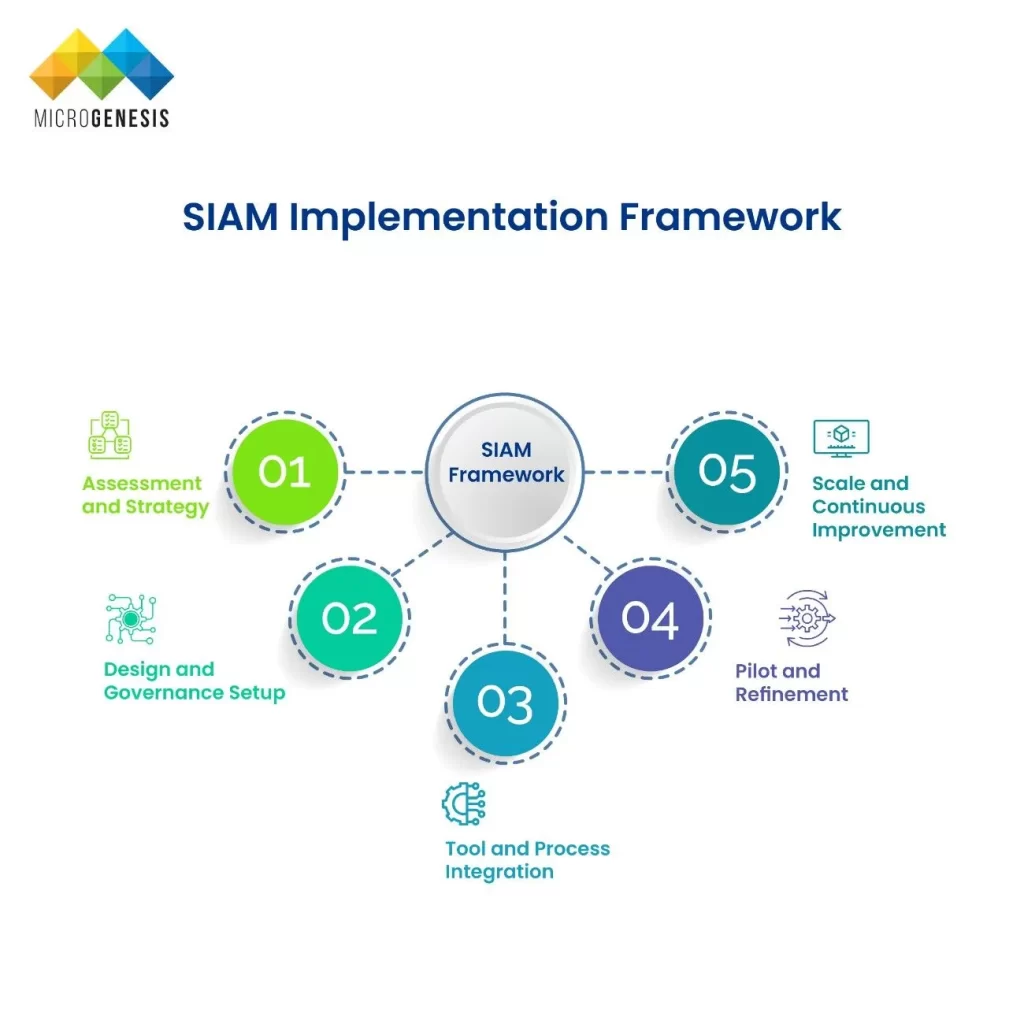
Phase 1: Assessment and Strategy
- Conduct a landscape analysis of all service providers, contracts, and SLAs.
- Identify integration pain points and redundancies.
- Define SIAM vision, goals, and success metrics.
- Choose an appropriate SIAM model (internal, external, hybrid).
Phase 2: Design and Governance Setup
- Create a SIAM governance framework with defined roles and escalation paths.
- Establish service catalogs, data ownership rules, and workflow blueprints.
- Define end-to-end processes and RACI models.
Phase 3: Tool and Process Integration
- Implement integration tools (ITSM platforms, APIs, dashboards).
- Define a shared CMDB for visibility across all vendors.
- Automate reporting and SLA tracking.
Phase 4: Pilot and Refinement
- Launch SIAM on a small scale (a specific service or vendor group).
- Gather lessons, optimize workflows, and refine KPIs.
Phase 5: Scale and Continuous Improvement
- Gradually expand to all services and providers.
- Regularly audit, analyze metrics, and adjust governance models.
Common Challenges in SIAM Implementation
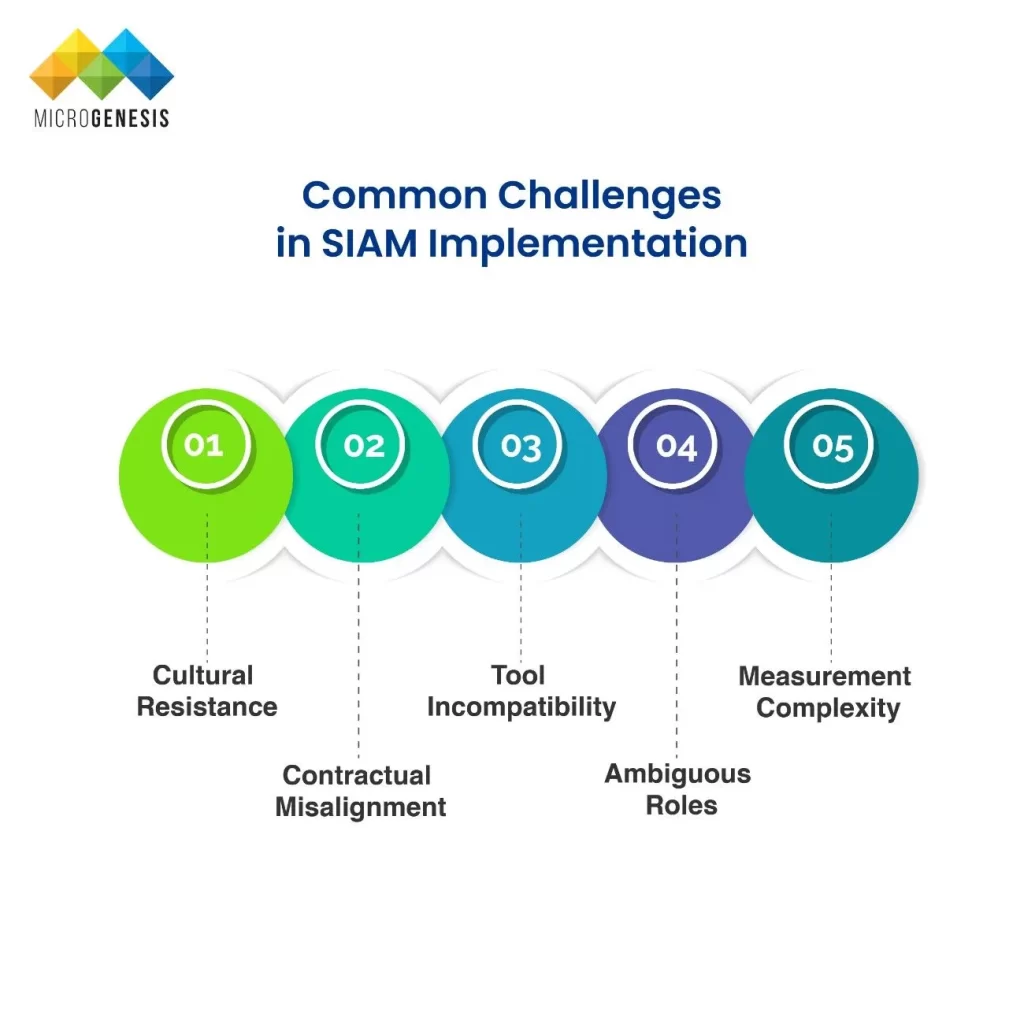
1.Cultural Resistance
Teams and vendors may fear losing autonomy.
Solution: Transparent communication, leadership support, and change champions.
2.Contractual Misalignment
SLAs across vendors often conflict.
Solution: Harmonize contracts and include joint KPIs that measure collective outcomes.
3.Tool Incompatibility
Different ITSM systems create integration silos.
Solution: Use middleware, APIs, or unified platforms to enable cross-provider visibility.
4.Ambiguous Roles
Without clarity, accountability breaks down.
Solution: Define clear RACI matrices and governance protocols.
5.Measurement Complexity
It’s hard to measure performance spanning multiple providers.
Solution: Focus on end-to-end service KPIs (availability, resolution time, business impact).
Key Metrics and KPIs for SIAM Success
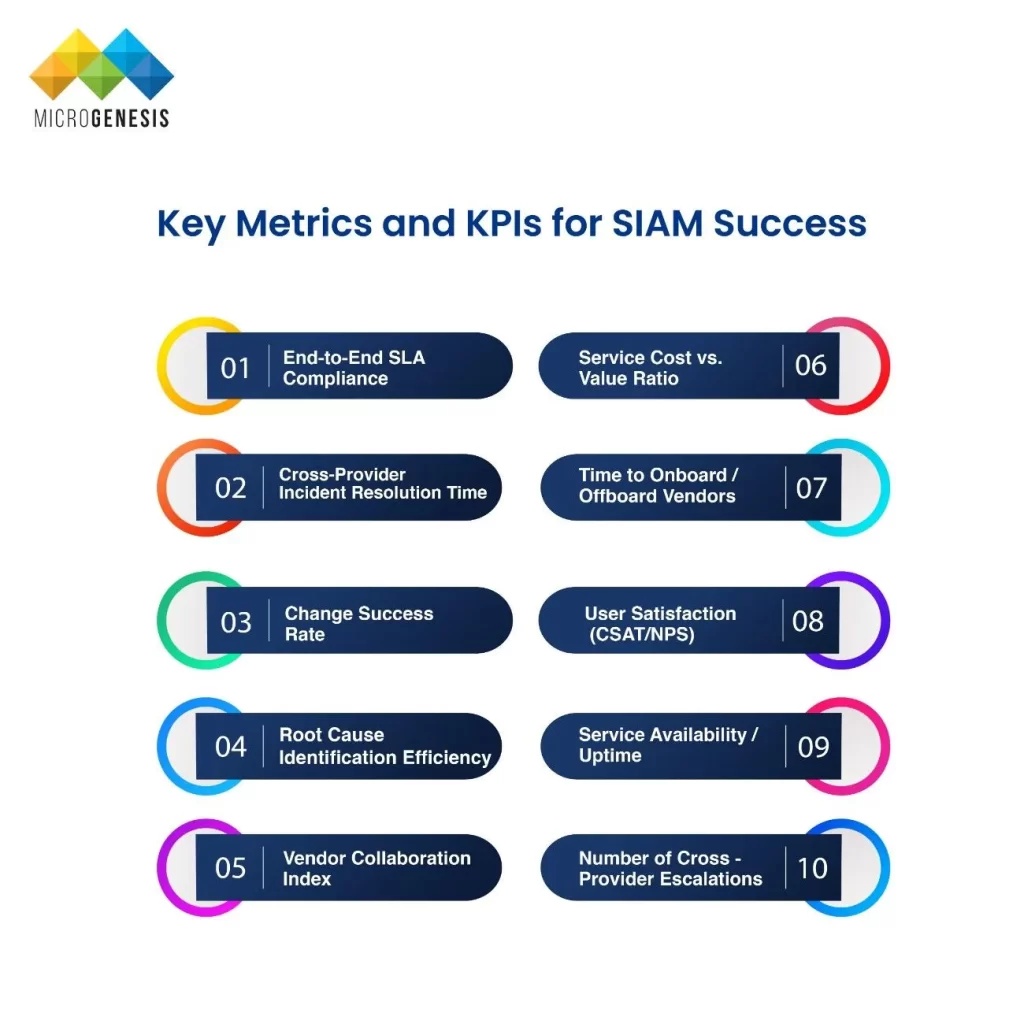
To measure SIAM success, organizations need to focus on end-to-end service outcomes rather than isolated vendor performance. Key metrics include:
1. End-to-End SLA Compliance
Measures whether the overall service meets agreed SLAs, ensuring that all providers collectively deliver a seamless experience.
2. Cross-Provider Incident Resolution Time
Tracks the average time to resolve incidents that span multiple vendors, reflecting coordination and escalation efficiency.
3. Change Success Rate
Percentage of changes implemented without causing incidents across all providers, indicating process alignment and reliable workflows.
4. Root Cause Identification Efficiency
Measures how quickly multi-vendor incidents are diagnosed, minimizing repeated disruptions and downtime.
5. Vendor Collaboration Index
A qualitative measure of how effectively vendors work together, helping identify communication or process gaps.
6. Service Cost vs. Value Ratio
Compares the total service delivery cost with business value, highlighting opportunities for optimization without compromising quality.
7. Time to Onboard/Offboard Vendors
Tracks the efficiency of integrating or retiring vendors, reflecting SIAM maturity and agility.
8. User Satisfaction (CSAT/NPS)
Captures end-user perception of service quality, supplementing technical KPIs with business-relevant feedback.
9. Service Availability/Uptime
Monitors overall service uptime across providers, ensuring critical business functions remain operational.
10. Number of Cross-Provider Escalations
Measures how often incidents require intervention from multiple vendors, highlighting integration or governance issues.
Dig Deeper: Top SIAM Metrics and KPIs for Multi-Vendor Success
Tools and Technologies Enabling SIAM
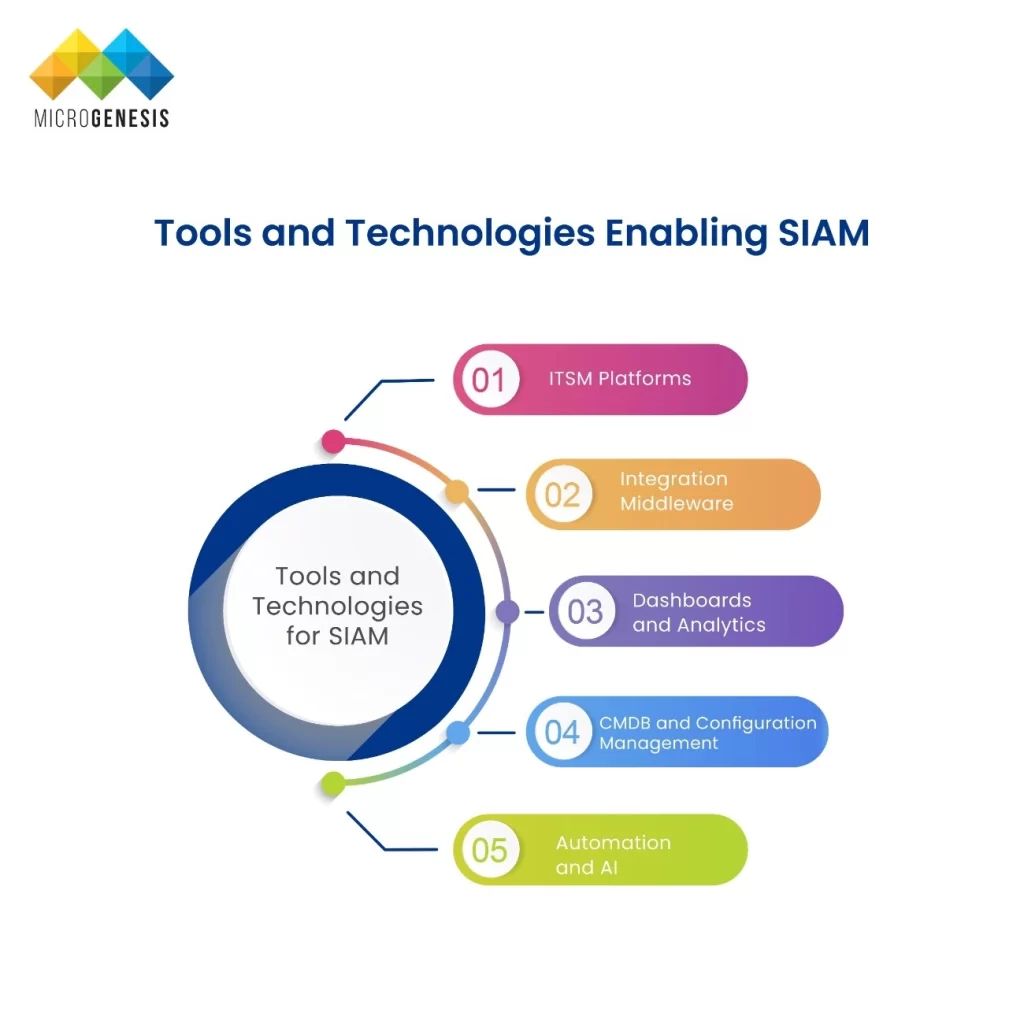
1.ITSM Platforms
Tools like ServiceNow, Jira Service Management, and BMC Helix support process harmonization and SLA tracking.
2.Integration Middleware
Platforms such as ONEiO or Zapier Enterprise connect disparate vendor systems via APIs, enabling real-time data exchange.
3.Dashboards and Analytics
Unified dashboards (e.g., Power BI, Grafana) offer visibility into end-to-end performance.
4.CMDB and Configuration Management
A shared Configuration Management Database provides a single source of truth across services, assets, and dependencies.
5.Automation and AI
AI-driven workflows can auto-route incidents, identify bottlenecks, and predict service degradation before it occurs.
Learn: Top 9 Future Trends in Service Integration and Management
SIAM Best Practices
Successfully implementing SIAM requires not only a structured framework but also adherence to proven best practices. These practices ensure that multi-vendor ecosystems operate efficiently, deliver consistent value, and continuously improve over time.
1. Define Clear Governance Early
- Establish a governance framework before integrating vendors.
- Clearly define roles, responsibilities, and decision-making authority to avoid overlapping powers.
- Implement a RACI matrix (Responsible, Accountable, Consulted, Informed) for each process to ensure accountability.
- Example: Incident escalation procedures should clearly specify whether the integrator or a specific vendor resolves cross-service issues, preventing delays or confusion.
2. Standardize Processes
- Harmonize ITSM processes (incident, change, problem, release, and configuration management) across all providers.
- Standardization ensures predictable workflows, reduces errors, and enables consistent reporting.
- Example: A unified change management process ensures that a configuration update in one provider’s system triggers coordinated actions across all dependent services.
3. Communicate Openly
- Foster a culture of transparency and collaboration across all vendors.
- Regular joint meetings, shared dashboards, and cross-provider updates help build trust and prevent siloed operations.
- Example: Weekly SIAM forums where providers review performance, share challenges, and propose improvements strengthen alignment and accountability.
4. Automate Wherever Possible
- Leverage automation to reduce manual handoffs, notifications, and repetitive tasks.
- Examples include automated incident routing, SLA tracking, reporting, and cross-vendor notifications.
- Automation minimizes errors, speeds up workflows, and allows teams to focus on strategic service improvement rather than administrative tasks.
5. Focus on Value
- Tie every process, workflow, and KPI to business outcomes rather than isolated technical metrics.
- Evaluate service delivery based on end-user impact, revenue contribution, or operational efficiency.
- Example: Rather than just tracking vendor SLA adherence, measure how service uptime affects customer satisfaction or business operations.
6. Measure Collaboratively
- Establish shared dashboards and metrics that all providers can access.
- Encourage joint accountability for KPIs such as end-to-end SLA compliance, incident resolution time, or change success rate.
- Collaborative measurement ensures that all providers prioritize overall service performance, not just individual targets.
7. Reward Cooperation
- Incentivize behaviors that enhance cross-provider collaboration and value delivery.
- Examples: Performance bonuses linked to joint KPI achievements or recognition programs for teams demonstrating exceptional cooperation.
- Reward structures reinforce the “one service, multiple providers” mindset rather than fostering siloed competition.
8. Iterate Frequently
- SIAM is a continuous improvement journey, not a one-time implementation.
- Regularly review governance, processes, metrics, and automation workflows to identify bottlenecks or improvement opportunities.
- Example: Quarterly SIAM maturity assessments can reveal gaps in collaboration, automation, or compliance, guiding next steps for optimization.
Also Read: Benefits of SIAM for Multi-Vendor Management in Europe
Case Example: SIAM in a Global Telecom Enterprise
A global telecom company managed over 15 service providers for infrastructure, customer support, and cloud operations. Service disruptions often led to blame games and missed SLAs.
Approach:
- Adopted a hybrid SIAM model with an external integrator.
- Implemented unified ITSM processes using ServiceNow.
- Introduced shared KPIs (e.g., end-to-end uptime).
- Conducted monthly “joint service reviews.”
Results:
- 35% faster incident resolution
- 20% reduction in operational costs
- Seamless customer experience across providers
- Stronger collaboration culture
Pro Tip: SIAM Best Practices | Lessons from Leading Enterprises
SIAM in the Cloud, Agile, and DevOps Era
Modern enterprises operate in increasingly complex, hybrid IT environments, combining on-premises infrastructure, public and private clouds, and SaaS applications. This complexity, coupled with the need for speed and agility, requires SIAM to evolve beyond traditional multi-vendor coordination.
Agile Alignment
- Agile development methods emphasize iterative delivery, cross-functional collaboration, and rapid feedback.
- In multi-vendor environments, Agile alignment ensures that all providers follow synchronized sprint cycles and release plans.
- Example: Multiple vendors contributing to a new digital product can coordinate backlog items, user stories, and sprint deliverables, ensuring seamless delivery without delays caused by misaligned priorities.
DevOps Integration
- DevOps promotes continuous integration, continuous delivery (CI/CD), and automated testing pipelines.
- SIAM ensures that DevOps practices span across vendors, maintaining traceability, version control, and deployment coordination.
- Example: A cloud provider and an external development vendor jointly deploy updates to a customer-facing platform, with SIAM orchestrating approvals, automated testing, and rollback procedures.
Cloud Coordination
- Organizations often rely on multiple cloud providers for compute, storage, or SaaS applications, creating interdependencies and SLA management challenges.
- SIAM harmonizes these SLAs and ensures that cross-cloud dependencies are managed effectively, reducing downtime and optimizing costs.
Security and Compliance
- Decentralized environments heighten security risks and regulatory compliance challenges.
- SIAM provides a centralized governance framework, ensuring consistent application of security policies, access controls, and audit trails across all providers.
- Example: A financial services firm using multiple cloud vendors can enforce a unified encryption standard, data residency rules, and compliance reporting through a SIAM layer.
Read more: How SIAM Supports Cloud, Agile, and DevOps Transformation
Conclusion
Service Integration and Management (SIAM) represents the next evolution of IT service governance. In a world defined by digital ecosystems and vendor diversity, SIAM provides the framework for accountability, agility, and alignment.
By mastering SIAM, organizations transform fragmented supplier networks into cohesive, value-driven ecosystems — improving performance, reducing risk, and enabling innovation.
When implemented strategically, SIAM is not merely a process framework; it is a competitive differentiator that empowers organizations to deliver consistent, customer-centric, and high-performing digital services.
How MicroGenesis Sweden AB Can Help in SIAM Services
MicroGenesis Sweden AB helps organizations successfully implement and optimize SIAM by aligning multi-vendor ecosystems with business goals, ensuring seamless service integration and governance.
Key capabilities include:
- SIAM strategy, consulting, and model selection
- Multi-vendor integration and governance setup
- ITSM tools implementation
- Process standardization across providers
- Automation, analytics, and performance tracking
FAQS
Service Integration and Management (SIAM) is a framework that coordinates multiple IT service providers to deliver a single, unified business service. It ensures end-to-end accountability, governance, and seamless collaboration across vendors.
SIAM works by introducing a service integrator that manages processes, tools, and communication across all vendors. It standardizes workflows, aligns SLAs, and ensures services are delivered as a cohesive system rather than isolated components.
The main goal of SIAM is to provide end-to-end service accountability, ensuring that business outcomes are achieved regardless of how many vendors are involved.
ITSM focuses on managing IT services within an organization, while SIAM extends ITSM to coordinate multiple external and internal service providers, ensuring unified service delivery across vendors.
SIAM is important because modern organizations rely on multiple vendors. It eliminates silos, improves collaboration, enhances visibility, and ensures consistent service quality across the entire ecosystem.
SIAM implementation includes:
Assessing current vendors and processes
Defining strategy and governance
Integrating tools and workflows
Running pilot programs
Scaling and continuous improvement
Common challenges include cultural resistance, tool incompatibility, unclear roles, misaligned contracts, and difficulty measuring cross-provider performance.
The best SIAM model depends on organizational maturity:
Internal model → high control
External model → expertise-driven
Hybrid model → balanced approach
Lead supplier → simple but risk of bias
SIAM implementation typically takes 3 to 12 months, depending on the number of vendors, organizational complexity, and existing ITSM maturity.
Common SIAM tools include:
ITSM platforms like ServiceNow and Jira Service Management
Integration middleware like ONEiO
Analytics tools like Power BI
CMDB systems for configuration management
SIAM improves service quality, enhances vendor collaboration, reduces costs, increases operational efficiency, and ensures better alignment between IT services and business goals.
Yes, SIAM reduces costs by eliminating duplicated efforts, improving vendor efficiency, optimizing processes, and enabling better resource utilization across providers.
SIAM improves service quality by standardizing processes, aligning SLAs, enabling real-time monitoring, and ensuring accountability across all service providers.
Yes, SIAM can be adapted for small businesses, especially those using multiple SaaS or cloud providers, though it is most beneficial for medium to large enterprises.
SIAM supports digital transformation by integrating cloud, DevOps, and multi-vendor services into a unified ecosystem, enabling agility, scalability, and faster innovation.
SIAM aligns DevOps and Agile practices across vendors by coordinating release cycles, automating workflows, and ensuring continuous integration and delivery across multiple providers.
Key SIAM KPIs include:
End-to-end SLA compliance
Incident resolution time
Change success rate
Service availability
Customer satisfaction (CSAT/NPS)
A SIAM operating model defines how services are structured across business, integration, provider, and governance layers to ensure seamless service delivery.
The service integrator is responsible for coordinating vendors, managing processes, ensuring SLA compliance, resolving conflicts, and maintaining end-to-end service performance.
Yes, SIAM is considered the future of IT service management in multi-vendor environments, as it enables organizations to manage complex ecosystems efficiently.